A Turkish walnut gunstock blank sells for $2,000 to $4,000 before a single cut is made. The buyer knows this going in. The seller states the price without ceremony. No one in that transaction spends time justifying it, because the culture surrounding fine rifles has already done that work. The wood is old-growth. The figure took decades to develop. The blank is scarce in the way that real things are scarce — not artificially, not by design, but because the tree grew once, in one place, and what it became cannot be ordered again. The price is simply what that fact costs.
The same logic governs the luthier's bench. A hand-built guitar from a maker who knows wood — who has spent years learning how spruce behaves across the grain versus along it, how Brazilian rosewood responds differently than Indian, how the tap tone of a top blank tells you what the instrument will sound like before it exists — commands $5,000 to $10,000 without apology. The hours are part of it. Some builders log 30, 40 hours or more, depending on the build. But the price is not an hourly rate. It is a transfer of accumulated judgment. The maker knew which board to pick up and which to set back down. That knowledge lives in the object. The buyer is paying for what will not decay: the decision-making, the material, the fact that this particular guitar will never be made again because the wood that made it is gone.
I build laminated bows. Longbows and recurves, engineered from the inside out — bamboo cores, performance fiberglass, aerospace composite — and finished with exotic hardwood risers that I select myself. The construction method is deliberate. Lamination is not a compromise. It is what allows a bow to store and return energy at the level these materials are capable of, consistently, over a lifetime of use. The wood at the riser is not decorative. It is structural. And it is chosen with an eye that was not developed at the bow bench.
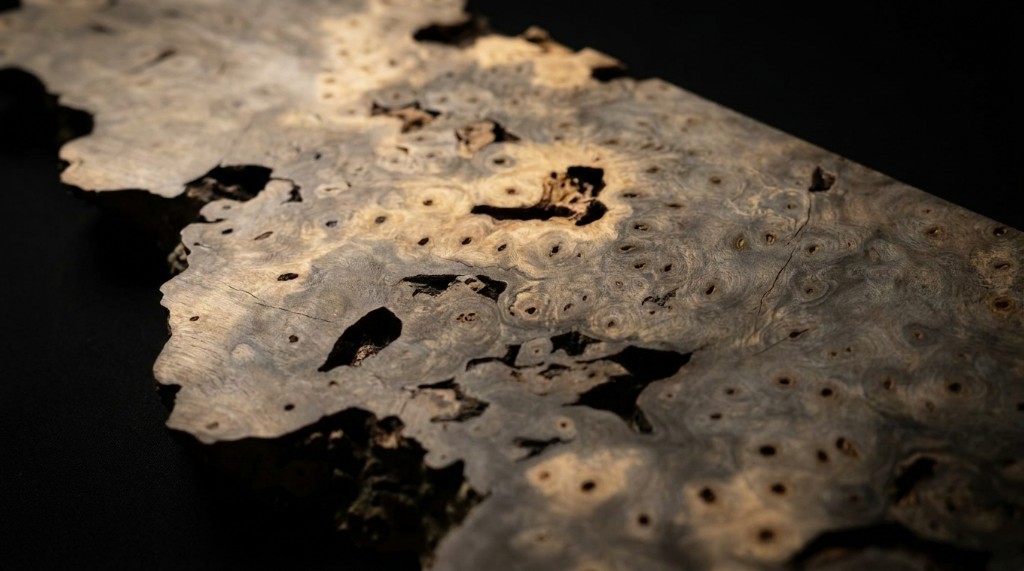
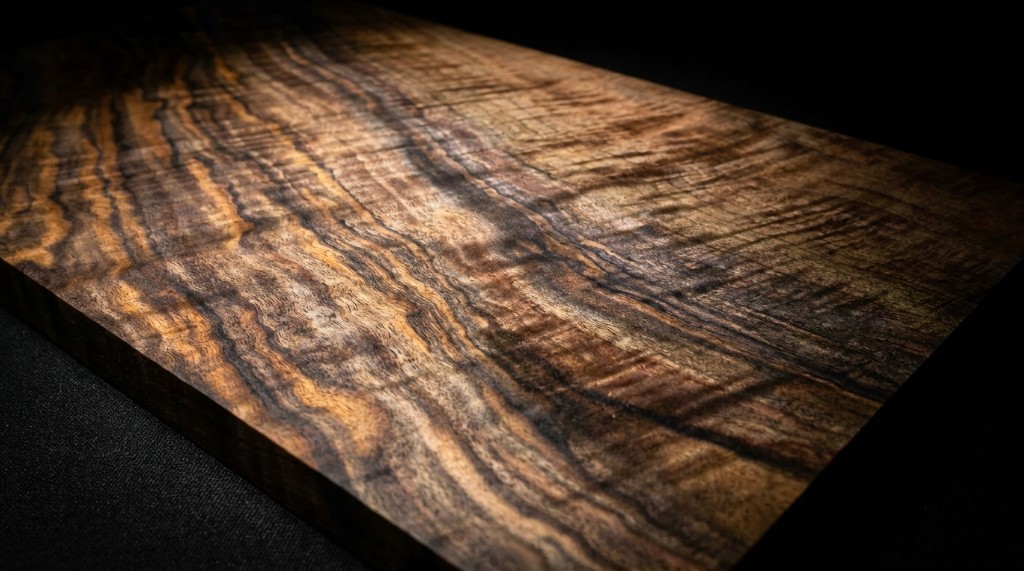
I have been working with exotic hardwoods since 2004. That history is not in my biography — it is in my hands. It is the reason I can stand in front of a stack of Mexican Kingwood blanks and know within seconds which ones are worth touching and which ones go back. The grain has to run correctly for what a laminated riser demands. The density has to be consistent in ways that reveal themselves to touch before they reveal themselves to measurement. The figure has to be worth building around — not just visually, but structurally, because in this application beauty and integrity are not separate considerations. They come from the same place in the wood, or they don't come at all.
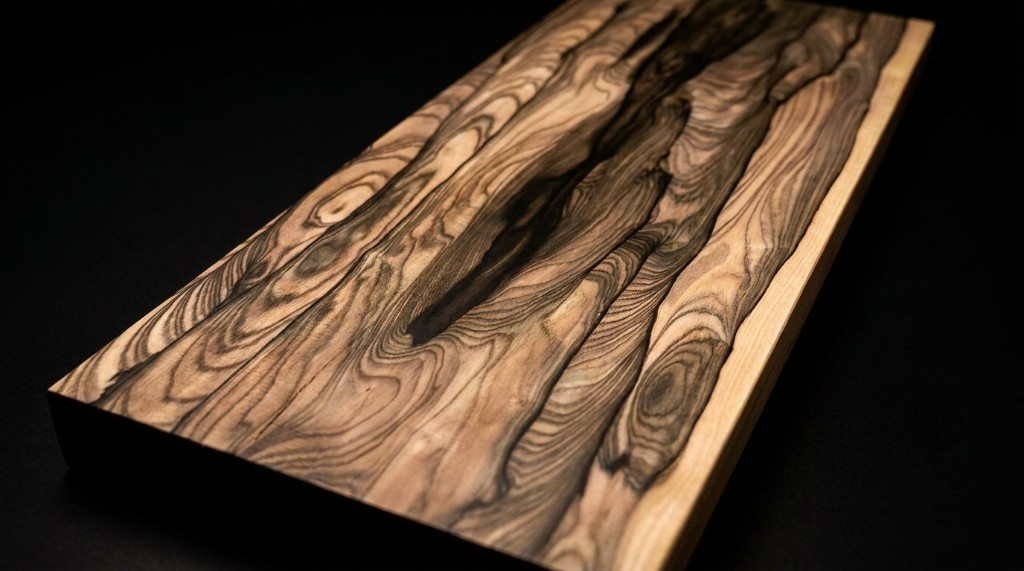
Most of what I find, I pass over. Desert Ironwood is among the densest hardwoods on earth and the supply of pieces worth working is genuinely thin. Black & White Ebony produces contrast figure that takes decades to develop and appears in usable dimensions rarely. Spalted Tamarind is marked by time in ways that cannot be replicated and cannot be rushed. When a board is right, I buy it. When the bow is built from it, that grain is gone. What ships is what existed. There is no reorder.
The build runs 30 hours at minimum. A laminated bow does not tiller the way a self bow does — you are not reading a single piece of wood and removing material until it bends correctly. You are working with a system: bamboo core, wood veneers, fiberglass, all bonded under heat and pressure into a single structure that behaves as one. The tillering happens through the geometry of the form the limbs are pressed on, the thickness of each laminate, the way those variables interact across the full length of the limb. Getting it right means understanding how each layer contributes to the whole — how the bamboo loads in tension, how the fiberglass controls the compression face, how a change in one dimension ripples through the rest. When the limbs come off the form and onto the tiller tree, the reading begins. If they don't bend the way the build demands, the answer is rarely simple. A limb that cannot be brought to standard gets scrapped. The hours in it are not a factor in that decision.
The finish is catalyzed lacquer that cures into the grain rather than sitting on top of it. The string is the fastest material made for the purpose. Every component is chosen because it is the correct component, not because it is the available one.
The traditional archery community has a reflex around price that is understandable and wrong. The democratization instinct runs deep here — archery is ancient, it belongs to everyone, and there is something in the culture that resists the idea of a bow costing what a fine instrument costs. That resistance has a kind of integrity to it. It also has a cost. It has produced a market where objects built from the same scarce hardwoods that gunsmiths and luthiers treat as precious are priced as though the wood came from a catalog. It has kept a category of craft — one that demands the same eye, the same hours, the same material knowledge — outside the conversation where it belongs.
That conversation is happening in other rooms. The buyer of a hand-built rifle stock already knows what old-growth walnut costs and does not flinch at it. The buyer of a luthier guitar already understands that the tonewood is irreplaceable and that the maker's judgment is part of what they are acquiring. These buyers are not different in kind from the person who commissions a bow built from Black & White Ebony with 30 hours of hand work and over 20 years of material knowledge behind it. They are simply operating in markets where the culture has already done the work of establishing value. The bow market has not done that work yet.
This is the work.
A laminated bow built from museum-grade exotic hardwood, engineered for performance and shaped entirely by hand, finished to a standard with no production equivalent, is not sporting equipment. It is a wood object. It will perform at the highest level the materials allow. It will look the same in fifty years that it looks today. It will outlast the person who commissioned it and mean something to the person who receives it after.
The luthier's buyer knows this without being told.
The gunstock maker's buyer knows this without being told.
The traditional bow community will know it too.
Written by
Reese Jones III
Founder & Bowyer · Imperator Bow Company
We guide each step: from wood selection through final delivery.